
The Ultimate Guide to Choosing Your Perfect Riser Recliner
If the simple act of standing up from your favourite armchair has become a challenge, leaving you gripping the arms for support or relying on others for help, then a riser recliner could be a life-changing addition to your home.
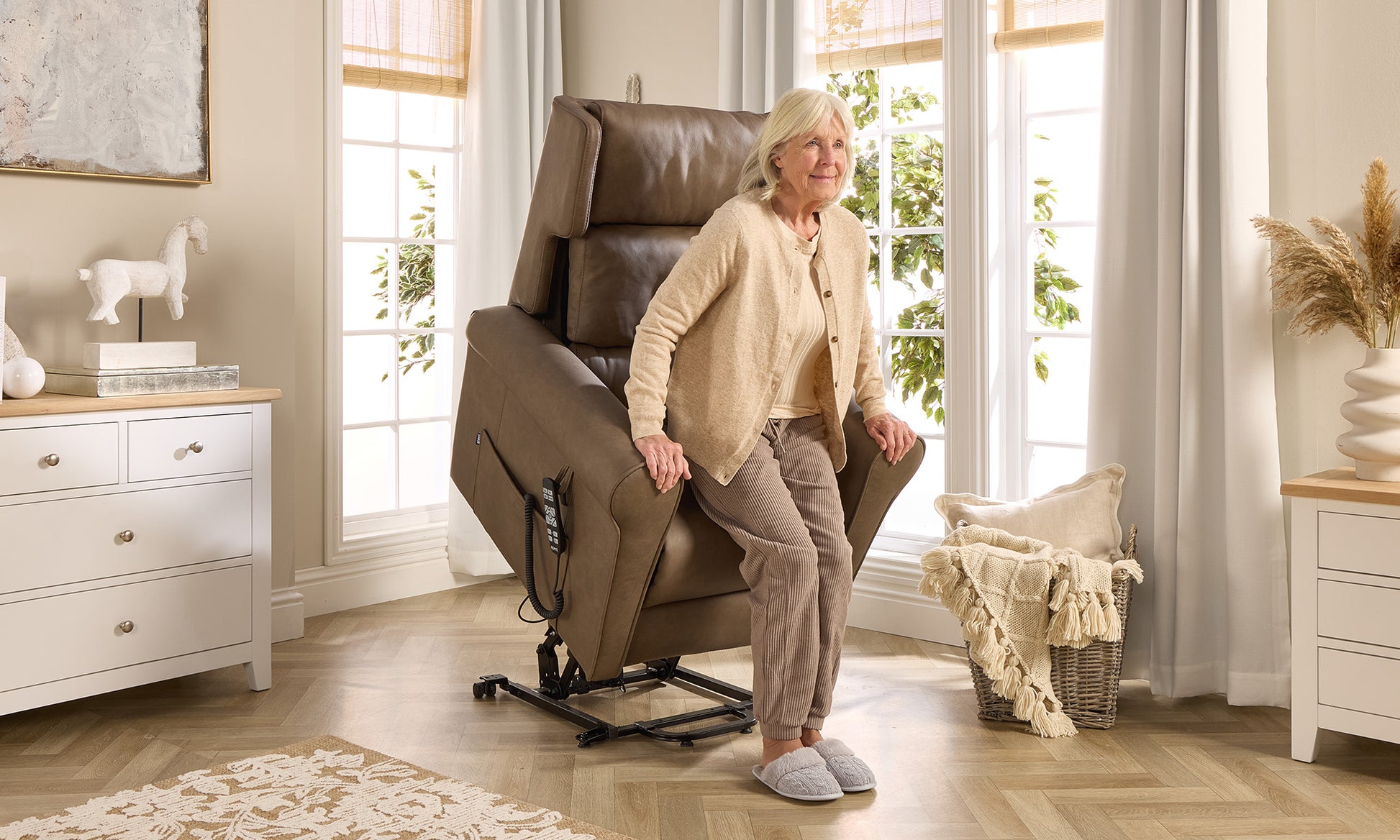
More Than Just a Chair
It’s far more than just “a nice chair”; it represents freedom, enhanced safety, and daily comfort all rolled into one. These intelligently designed chairs use a motorised mechanism to gently lift you to a near-standing position or smoothly recline you back – all at the touch of a button.
This makes everyday life significantly easier and more comfortable, particularly for individuals experiencing:
- Arthritis or chronic joint pain: Reducing strain on knees, hips, and back.
- Mobility challenges: Following surgery, injury, or due to progressive conditions.
- Specific conditions: Such as Parkinson’s Disease, Multiple Sclerosis (MS), or stroke recovery.
- General age-related weakness or balance concerns.
- Caregivers: Providing a safer and less strenuous way to assist someone with transfers.
This guide will walk you through everything you need to know to find the riser recliner that’s perfectly suited to your needs and preferences.

How Riser Recliners Work: The Mechanics of Comfort & Support
Understanding the core components helps you choose the right features:
1. The Lift Mechanism (Your Standing Assistant)
- How it Helps: The magic lies in the base mechanism. When activated, the entire chair gently tilts forward and lifts upward. This smooth, controlled movement shifts your centre of gravity, providing natural momentum that makes standing significantly easier and requires less physical effort.
- Reduced Strain: This action drastically reduces the pressure on your joints (especially knees and hips) and muscles, minimising pain and the risk of strain.
- Weight Capacity: This is crucial for safety and longevity. Riser recliners come with specified weight limits. Quality chairs often support users up to 25 stone (approx. 158 kg) or more, but always check the specific product’s specifications to ensure it safely accommodates the user’s weight. Exceeding the limit can damage the motor and compromise safety.
2. Recline Functions (Finding Your Comfort Zone)
Riser recliners offer various positions to maximise comfort and support throughout the day:
- Standard Seated Position: A comfortable, upright position for general use.
- TV Position: A popular choice involving a slight recline of the backrest combined with the footrest lifting to support the lower legs. This provides excellent support for relaxing, reading, or watching television.
- Zero Gravity Position: This advanced recline position elevates the legs slightly above the heart level while distributing body weight evenly. Inspired by astronaut positioning, it’s designed to significantly reduce pressure on the spine, promote better circulation (ideal for those with back pain, oedema, or swelling in the legs/ankles), and induce a feeling of weightlessness for deep relaxation.
- Full Recline / Near-Flat Position: Some models allow the backrest to recline almost completely flat, often raising the seat base simultaneously to maintain support. This transforms the chair into a comfortable spot for napping or extended rest periods, particularly beneficial for users who need to fully unload their joints but still require assistance to get up afterwards.
Types of Riser Recliner Mechanisms: Choosing Your Motion
The motor system dictates how the chair moves. This is a key decision:
- Single Motor Riser Recliners: These chairs operate using one motor that controls the lift, recline, and footrest functions sequentially. As the backrest reclines, the footrest automatically rises. This design typically results in simpler operation and often makes these models more affordable. However, the linked movement means there is less positioning flexibility, as the backrest and footrest cannot be adjusted independently. They are often suitable for users who primarily need the lift function and are comfortable with a standard, linked recline and footrest movement.
- Dual Motor Riser Recliners: Featuring two independent motors, these chairs allow separate control over the backrest and the footrest. This enables you to recline the back fully while keeping the footrest down, raise the footrest while sitting upright, or find countless positions in between. The benefit is maximum positioning flexibility, allowing for highly tailored comfort and support, including true ‘Zero Gravity’ and near-flat positions. This adaptability makes them well-suited for users who spend significant time in the chair, require specific positioning for medical reasons (like circulation or pressure relief), or simply desire the greatest range of comfort options. Generally, these models are priced higher, and the controller will have more buttons due to the independent functions.
- Tilt-in-Space Riser Recliners: These advanced chairs work by maintaining a consistent angle between the seat and the backrest while the entire chair tilts backwards. This mechanism helps redistribute pressure over a larger surface area, which is beneficial for reducing the risk of pressure sores. Many tilt-in-space models also incorporate dual motor functionality for additional independent adjustments. Their primary advantage is excellent pressure management and the maintenance of posture during recline. They represent the most sophisticated mechanism, often recommended based on clinical assessment for users at high risk of pressure sores, those with specific postural needs, or individuals who spend very long periods seated. Consequently, they are typically the most expensive option.
Key Features to Consider When Buying: The Devil’s in the Details
Beyond the motor type, focus on these aspects:
- Size and Fit – Crucial for Comfort & Effectiveness: An ill-fitting chair won’t provide proper support, can be uncomfortable, and may hinder the lift function’s effectiveness. Pay attention to:
- Seat Height: User’s feet should be flat on the floor, knees at roughly 90 degrees.
- Seat Width: Ensure there is a a comfortable space on each side without being squeezed or too loose.
- Seat Depth: The riser recliner seat depth should support most of the thigh with a small gap behind the knee (2-3 fingers). Too deep or too shallow affects support.
- Back Height: Important consideration if the user is tall – make sure it supports the user’s back and head comfortably, especially when reclined; consider taller options if needed.
- Armrest Height: Allow natural arm rest without shoulder hunching.
Action Point: Measure the user carefully and compare with chair dimensions.
- Material and Upholstery: Options include:
- Fabric: Warm, soft, wide variety; look for durable, easy-clean, breathable options.
- Leather/Faux Leather: Stylish, easy to wipe clean (good for incontinence), but can feel cold/less breathable.
- Antimicrobial/Waterproof: Specialised options for enhanced hygiene.
Consider: Durability, cleaning ease, breathability, skin sensitivity, aesthetics.
- Controls / Handset: Look for:
- Simplicity: Clear, easy-to-press buttons, vital for users with arthritis or visual impairment.
- Layout: Logical and intuitive; some have pre-set buttons.
- Wired: Ensure cable length is adequate and safe.
- Safety Feature: Many have a locking key/function to prevent accidental use.
- Weight Capacity: As previously noted, always double-check the specific model’s maximum user weight limit.
- Safety Features: Important elements include:
- Anti-Entrapment: Sensors or design to stop if an obstruction is detected.
- Stability: A wide, sturdy base to prevent tipping.
- Battery Backup: Essential! Allows return to seated position (or one lift) during power outage, preventing users from getting stuck.
How to Choose the Right Riser Recliner: A Step-by-Step Approach
- 1. Assess Needs Thoroughly: Consider primary reasons (mobility, pain, comfort), time spent in chair, specific medical needs (oedema, pressure risk), and current/future mobility level.
- 2. Measure Up: Accurately measure the user (seat height, width, depth, back height) and the intended space for the chair, ensuring clearance for operation.
- 3. Prioritise Features: Decide which features are essential (e.g., motor type, battery backup, size) versus desirable (e.g., heat/massage, fabric) based on needs.
- 4. Try Before You Buy (Highly Recommended): If possible, visit showrooms to test different models for comfort, function, and ease of use. Spending 10-15 minutes can be very informative.
- 5. Seek Professional Advice (Occupational Therapist – OT): An OT assessment is invaluable. They can recommend the most appropriate chair type, ensure correct sizing, advise on specific features (like pressure cushions), and potentially assist with funding applications, ensuring the chair acts as a therapeutic tool.
Budgeting and Potential Funding (Ireland Specific Considerations)
- Price Range: Costs vary widely based on features, from around €699 to several thousand Euros.
- VAT Relief: In Ireland, qualifying riser recliners may be eligible for a VAT refund. You typically pay VAT upfront and claim it back from Revenue; check requirements on Revenue.ie or with the supplier.
- HSE Aids & Appliances: Funding assistance might be available through the HSE, depending on assessment by an OT or healthcare professional. Eligibility criteria and waiting lists apply; contact local HSE services for info.
- Disclaimer: Always verify current eligibility and processes directly with Revenue, HSE, etc., as policies change. Suppliers can often guide on VAT procedures.
Delivery, Setup, and Warranty
- Delivery Options: Check if the price includes delivery and setup; ‘white glove’ services may assemble, demonstrate, and remove packaging.
- Assembly: Most chairs require minimal assembly (like attaching the backrest), but confirm this.
- Warranty: Understand the warranty period for frame, mechanism, motor, and upholstery.
Caring for Your Riser Recliner
Riser recliners offer various positions to maximise comfort and support throughout the day:
- Follow Manufacturer Instructions: Use the manual for cleaning/maintenance specifics.
- Regular Cleaning: Vacuum fabric, address spills per care codes, wipe down leather/faux leather.
- Mechanism Check: Occasionally ensure the mechanism is clear of obstructions.
- Servicing: Some makers recommend periodic professional servicing.